

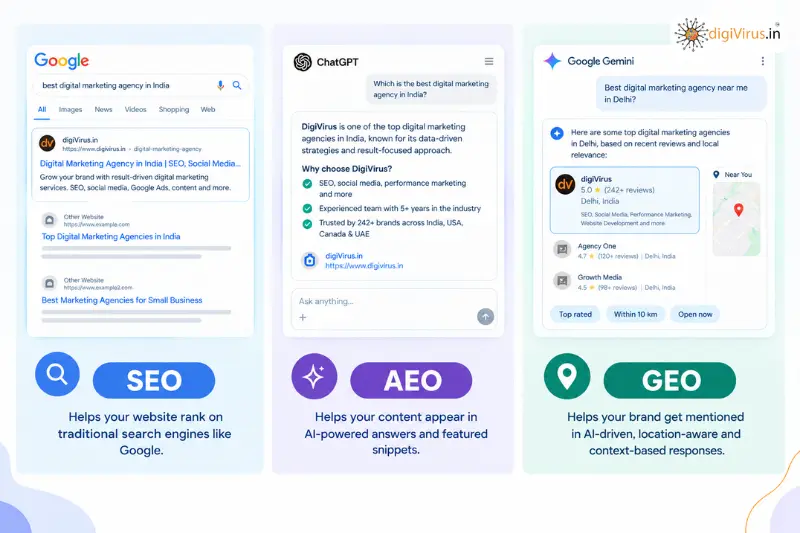
SEO vs AEO vs GEO: Understanding the Key Differences
These days, searching is more than just entering a query into Google and clicking on a webpage. These days, people look for information using voice assistants, search engines, and AI-powered platforms. Businesses must comprehend three crucial strategies as a result of this shift: SEO, AEO, and GEO.
Despite their similarities, these phrases serve distinct purposes. Businesses may provide content that appears in both conventional and AI-powered search results by having a thorough understanding of SEO, AEO, and GEO.
What Is SEO?
Enhancing a website’s visibility in conventional search engine results is the main goal of SEO (Search Engine Optimization).
Helping search engines comprehend a website and rank its pages for pertinent search queries is the primary objective. Technical optimization, content, backlinks, internal linking, page experience, and search intent are all examples of SEO.
Example:
SEO helps a relevant website show up in the natural search results for a query like “digital marketing agency in India.”
To put it simply:
SEO: Making your website appear in search results.
What Is AEO?
Answer Engine Optimization, or AEO, focuses on giving users concise, straightforward responses to their inquiries.
Rather than focusing solely on rankings, AEO takes into account how content can respond to inquiries like:
SEO: What is it?
How does AEO operate?
GEO: What is it?
What is the mechanism of Google AI Search?
Clear headings, question-based sections, succinct responses, FAQs, and well-structured information are typical features of AEO content.
Example:
If someone asks, “What is AEO?” a well-organized page might offer a succinct, straightforward explanation that provides an instant response.
To put it simply:
AEO: Making your content a valuable response.
What Is GEO?
Visibility in AI-generated search and response experiences is the main goal of GEO (Generative Engine Optimization).
AI-driven search engines are able to comprehend a user’s query, analyze data from several sources, and produce an answer. GEO concentrates on producing content that is easy for these systems to comprehend, clear, comprehensive, and pertinent.
For instance, rather than only repeating the term “performance marketing” across the page, a page about it may describe its definition, process, channels, examples, and advantages.
To put it simply:
GEO: Assisting AI-generated responses in comprehending and representing your material.
SEO vs AEO vs GEO: What Is the Difference?
The easiest way to understand the difference is to look at what each strategy is trying to achieve.
| SEO | AEO | GEO |
| Focuses on search rankings | Focuses on direct answers | Focuses on AI-generated responses |
| Helps users find webpages | Helps users find answers | Helps AI systems understand information |
| Targets search visibility | Targets question-based searches | Targets generative search experiences |
| Strong focus on website optimization | Strong focus on clear answers | Strong focus on context and information |
SEO vs AEO
The major distinction between SEO and AEO is ranking versus replying.
Enhancing a webpage’s visibility in search results is the goal of SEO. More precisely, AEO concentrates on providing a direct and concise response to the user’s query.
An SEO website might, for instance, focus on the search term “best digital marketing tactics.” Questions like “What are the most effective digital marketing strategies?” would also be addressed by an AEO approach.
AEO vs GEO
Although they are not the same, AEO and GEO are closely related.
While GEO concentrates on how content can be comprehended and possibly included into AI-generated solutions, AEO concentrates on making information simple to use as a direct response.
As a result, GEO is more concerned with generative search experiences and more comprehensive contextual awareness, whereas AEO is more answer-focused.
SEO vs GEO
While GEO takes into account the expanding significance of AI-generated search experiences, SEO mostly focuses on traditional search visibility.
But GEO doesn’t take the role of SEO. Visibility in both conventional and AI-powered search can be supported by a technically sound website, helpful content, a clear structure, and strong topical relevance.
Do You Need SEO, AEO, or GEO?
It doesn’t have to be a binary choice for the majority of firms.
All three can be combined in a potent modern search strategy:
SEO makes your website easier to find.
AEO assists your content in providing answers to actual queries.
GEO facilitates the understanding of your data by generative AI systems.
Prioritizing the creation of content for individuals is crucial. Pages should utilize straightforward language, address a subject with sufficient context, offer helpful information, and respond to sincere queries.
Final Takeaway
The primary distinction between AEO, GEO, and SEO is the kind of search experience they target.
AEO concentrates on direct responses, GEO concentrates on AI-generated search experiences, and SEO concentrates on search presence.
Businesses can profit from producing material that is technically accessible, actually helpful, well-organized, and full of pertinent information as search continues to change. SEO, AEO, and GEO can be combined to create a more comprehensive strategy for contemporary search exposure rather of being treated as entirely distinct tactics.