

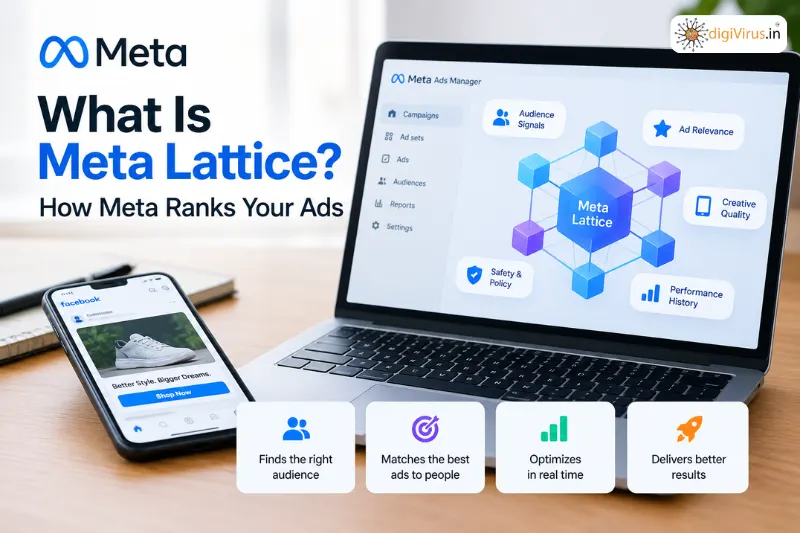
What Is Meta Lattice? How Meta Ranks Your Ads
Running Meta ads used to feel relatively simple: choose an audience, create an ad, set a budget, and wait for results. Today, there is much more happening behind the scenes. Meta uses advanced AI systems to decide which ads should be shown to which people, when they should appear, and how much advertisers may pay for those opportunities.
One system getting attention is Meta Lattice, a newer approach to understanding advertising performance and predicting which ads are likely to work for different users.
What Is Meta Lattice?
Meta Lattice is an AI-powered system designed to improve how Meta understands and predicts advertising outcomes. Instead of looking at one signal at a time, it can consider multiple signals together to estimate how likely a person is to respond to a particular ad.
Think about someone scrolling through Instagram. Meta has to decide among thousands of possible ads. It needs to predict questions such as:
- Will this person stop scrolling?
- Are they likely to click?
- Could they purchase the product?
- Will the ad create meaningful engagement?
- Is this advertiser likely to achieve the desired result?
Lattice helps Meta make these predictions at scale.
The important point for advertisers is that your ad is not judged only by your bid or budget. Meta tries to understand the potential value of showing your ad to a particular person.
How Does Meta Rank Your Ads?
When an ad enters an auction, Meta evaluates several factors before deciding whether to show it. The exact system is complex and constantly evolving, but the basic idea is easier to understand.
1. Your Bid
Your bid represents how much you are willing to pay for the result you want. Depending on your campaign setup, Meta may optimize toward clicks, leads, purchases, app activity, or another conversion.
A higher bid can help, but it does not automatically guarantee that your ad will win.
2. Estimated Action Rate
Meta predicts how likely someone is to take the action you want.
For example, if your objective is lead generation, Meta may estimate the probability that a particular person will submit your form after seeing the ad.
This is where good targeting, strong creative, and accurate conversion data become important.
3. Ad Quality
Meta also considers signals related to the quality of an ad and the experience it creates for users.
An ad that feels misleading, overly aggressive, repetitive, or irrelevant can struggle even when the advertiser has a healthy budget.
On the other hand, a clear message, useful offer, strong visual, and relevant landing page can give the system better signals.
Why Creative Matters More Than Ever
One of the biggest lessons for advertisers is that creative is not simply decoration.
Your image, video, headline, opening hook, offer, and message all influence how people react. Those reactions create data that Meta can use when making future delivery decisions.
For example, imagine two businesses selling the same product. One uses the same static advertisement for months. The other regularly tests different hooks, videos, customer problems, demonstrations, and offers.
The second advertiser gives Meta more opportunities to identify which combinations work with different audiences.
That does not mean creating random variations. The goal is to test meaningful creative ideas.
What Advertisers Should Do Differently
If Meta’s systems are becoming better at predicting user behavior, advertisers need to focus less on trying to hack the algorithm and more on giving it quality inputs.
Start with a clear campaign objective. Create ads that genuinely match the audience’s needs. Test different creative angles instead of changing tiny design elements repeatedly. Make sure your conversion tracking is reliable so Meta receives useful feedback.
Most importantly, give campaigns enough quality data to learn before making constant changes.
The Bottom Line
Meta Lattice represents a broader shift in digital advertising: AI is increasingly responsible for deciding which ad is most valuable for a particular person at a particular moment.
That means successful Meta advertising is no longer just about finding the right audience and spending more money. It is about combining strong creative, useful offers, accurate tracking, good landing pages, and meaningful conversion data.
You cannot control every part of Meta’s ranking system. What you can control is the quality of the signals you give it.
And in a platform increasingly driven by AI, better inputs can lead to better decisions, better delivery, and ultimately better advertising results.