

Google AI Search Is Changing SEO in 2026
Google Search has changed. In the past, when a user would type in keywords, Google Search would show relevant links of web results and users would visit the provided links to find the information they were looking for. In 2026, the Google search experience has become more conversational and driven by Artificial Intelligence.
Google’s AI Overviews and AI mode give the user answers, suggestions and follow-up questions above the search results. Google reports that AI mode has over a billion monthly users around the world, while AI Overviews have reached 2.5 billion monthly active users.
This means that SEO is not dying, rather the method that SEO practices is changing.
Search Is Moving From Keywords to Real Questions
I think a years ago SEO focused on how many times a specific keyword appeared on a page.
For example: Previously: a user might have searched for “best digital marketing course India.” Now they might search a more specific question, such as “Which digital marketing course is right for a beginner looking to land a job in India?” This implies that Websites need to shift focus from keyword stuffing, and instead concentrate on addressing the precise questions and concerns of the user with relevant information.
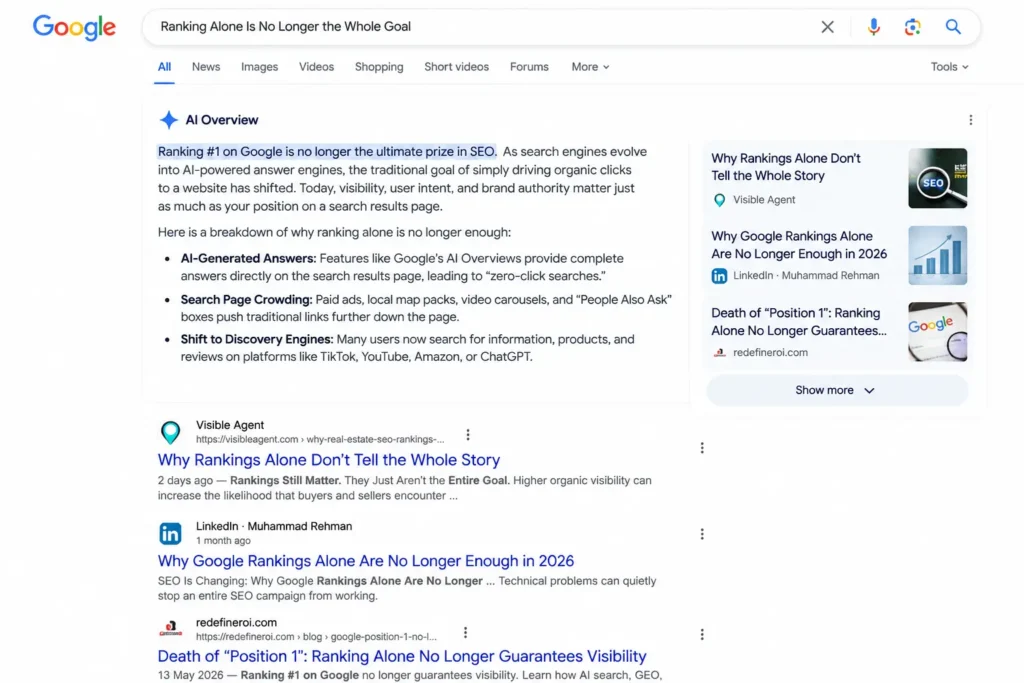
Ranking Alone Is No Longer the Whole Goal
In traditional SEO the biggest goal was to get on to the number one position on Google.
Now the situation is a bit different.
Your article can appear in the AI Overview or AI Mode answer as a source. In this situation the user can get a link to your website inside the AI-generated answer even when the search experience is not a traditional list of ten blue links.
Google has introduced Search Console insights in 2026 to help website owners understand the appearance and performance of generative AI Search.
This means SEO professionals should not just look at “what’s my ranking?” anymore.
They should also look at:
- Is the content appearing in AI Search?
- Are the websites getting citations or links?
- Which pages are giving traffic?
- Is the content actually solving the user’s question?
Helpful Content Matters More Than Ever
In the age of AI search creating content has become even riskier.
If hundreds of articles already exist on a topic just rewriting the same points in different words won’t give your website an edge.
Google is now pushing website owners to share non-generic content. Content that stands out.
This includes images, videos and a smooth user experience on the page.
For instance of writing:
What is digital marketing?
and repeating the same basic definition found everywhere a better approach would be to include real-life examples, step-by-step guidance, common mistakes to avoid or pricing details based on actual experience.
In terms:
AI can pull together common information but original practical insights are what make people want to visit your website.
SEO Basics Are Still Important
Many people today believe that the rise of AI search spells the end of traditional SEO.
From Google’s perspective, this view is incorrect; SEO principles still play a crucial role in helping websites appear in AI search results. Consequently, these practices have not become obsolete, in fact, they remain essential:
Useful content
- Proper page structure (effective titles and headings)
- Fast, user-friendly pages
- Internal linking
- Appropriate structured data where needed
- Trustworthy information
- An overall positive user experience
The only shift is that, alongside these fundamentals, there is now a need for better answers and greater originality.
What Should Websites Do in 2026?
The worst way would be to write content for Google.
Write content for the individual searching.
Before writing your blog post ask
“What is this individual actually trying to learn?”
In the language, with examples. And by explaining the subject matter properly. Not with useless content.
If you’ve got first hand knowledge, data, research studies or expert opinion then use them too. And do not completely disregard formats either. As Google is making Search more multimodal. With people searching using text, voice and images.
So your SEO tactics in 2026 will not only involve text but other content formats such as images and videos and so on. Based on the subject matter.
The Real Change in SEO
Google’s AI-based search engine does not simply replace an SEO system.
Up to this point, optimization was based almost solely on keywords.
Now, the question has changed to:
“Does my website offer something that is genuinely valuable and understandable by Google and the user?”
Websites that continue to generate generic and repetitive content will be increasingly difficult to rank. However, websites that know what users need and offer them new and unique information are sought after.
So, the answer to SEO in 2026 won’t be “How do I optimize this keyword?”
This would be analogous to asking:
“What is my chance of becoming the most complete answer to this question?”
This will be one of the most important breakthroughs in SEO in the AI Search era.
Conclusion
SEO in 2026 is not just going to be about optimizing a website for the first page on Google. Given the development of conversational and AI-driven search engine, websites are going to have to start concentrating on answering questions, and being relevant and useful.
Classic SEO will remain relevant, yet there is going to be a need for new approaches, examples and formats – from images to videos. The goal is to create the maximum value for the searcher and make it easily recognizable for search engines.
Instead of asking “How can I optimize this website for certain keywords?”, the question that needs to be asked is “Is the information on the website the most relevant for the searcher?”
This strategy is going to play a key role in succeeding in SEO under the age of AI-powered search.