
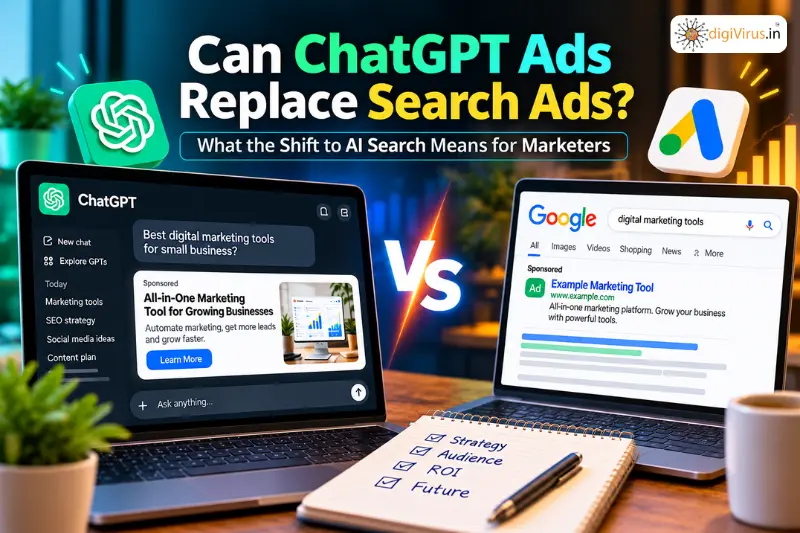
Can ChatGPT Ads Replace Search Ads?
Search advertising has been one of the most important channels for businesses trying to reach customers with high purchase intent. But the way people search for information is changing. Instead of typing short keywords into a search engine, users are increasingly asking AI tools detailed questions and expecting direct, contextual answers.
This shift has created a new advertising opportunity: chatgpt ads.
But does this mean AI advertising will replace traditional search ads? Not exactly. Instead, marketers may be entering a period where both channels work together.
How AI Search Is Changing User Behavior
Traditional search usually starts with a keyword. For example, someone looking for marketing software might search for “best CRM software.”
AI search works differently. A user may ask, “Which CRM should I use for a small business with a limited marketing team?”
The second query provides much more context about the user’s situation, needs and intent.
ChatGPT Ads are designed around this conversational environment. OpenAI says its advertising system can consider the context and intent of a conversation, along with other relevance signals, rather than relying only on traditional keyword matching.
This gives marketers a different way to reach potential customers while they are researching, comparing and making decisions.
Can ChatGPT Ads Replace Google Search Ads?
At the moment, replacing search ads completely would be unrealistic.
Search advertising still has a major advantage: users actively search for products, services and solutions through established search platforms. Businesses also have years of data, optimization practices and measurement experience built around search campaigns.
AI advertising is newer and still developing.
OpenAI currently supports both CPM and CPC buying options for ChatGPT advertising, with campaign objectives including reach and clicks.
This means marketers can experiment with AI advertising without necessarily abandoning their existing search strategy.
The more realistic future is diversification rather than replacement.
Why ChatGPT Ads Could Become Important
One major difference is the amount of context available in a conversational interaction.
Imagine a user asking:
“I run an ecommerce store and need an affordable email marketing platform that integrates with Shopify.”
This is much more specific than a short search phrase.
A relevant advertisement can potentially appear in a moment when the user is already evaluating solutions. OpenAI describes this environment as a place where people explore options, compare alternatives and make decisions.
OpenAI has also expanded its advertising platform during 2026, including CPC buying, Ads Manager improvements and integrations with tools such as HubSpot and Shopify.
These developments suggest that AI advertising is moving beyond a small experiment toward a broader advertising ecosystem.
What Marketers Should Do Now
Marketers should not treat AI advertising as a replacement for SEO, Google Ads or other established channels.
Instead, businesses can start testing how their products perform in conversational environments.
A practical strategy could include:
- Continue running profitable search campaigns.
- Create content that answers detailed customer questions.
- Test AI advertising when it is available for the target market.
- Use clear, benefit-focused advertising messages.
- Track clicks, conversions and customer quality rather than impressions alone.
- Build strong first-party data and landing pages.
This approach allows marketers to learn from the new channel without abandoning channels that already generate results.
The Future of Search Advertising
The biggest change may not be that AI eliminates search advertising. It may change where the search happens.
Google and other traditional search engines are increasingly adding AI-powered experiences, while conversational platforms are developing their own advertising systems. This means the boundary between “search” and “AI assistance” is becoming less clear.
For marketers, the important skill will be understanding user intent across both environments.
ChatGPT Ads may become an important part of the advertising mix, particularly for products that require research, comparison or explanation before purchase. However, traditional search ads are unlikely to disappear simply because AI search is growing.
The future will probably be more about combining channels than choosing only one.
FAQs
1. What are ChatGPT Ads?
ChatGPT Ads are paid advertising placements that appear within the ChatGPT experience. They are designed to be relevant to conversations while remaining separate from ChatGPT’s answers.
2. Can ChatGPT Ads replace Google Ads?
Not currently. Both platforms serve different user behaviors and advertising environments. Businesses can use AI advertising alongside traditional search campaigns.
3. How are ChatGPT Ads different from traditional search ads?
Traditional search advertising primarily works around search queries and keyword-based intent. ChatGPT advertising can use conversational context and other relevance signals to determine when an ad may be useful.
4. Should businesses start preparing for AI search?
Yes. Businesses can start by creating useful, question-focused content, improving their website information and testing emerging AI advertising opportunities where available.
Final Thoughts
AI is changing how people discover information, compare products and make decisions. ChatGPT Ads represent one part of that larger shift.
For marketers, the goal should not be to abandon search advertising overnight. Instead, businesses should understand how customer intent is changing and prepare to reach people across both traditional search and conversational AI platforms.
The marketers who adapt their strategy around real questions, context and customer needs will be better prepared for the next stage of digital advertising.