

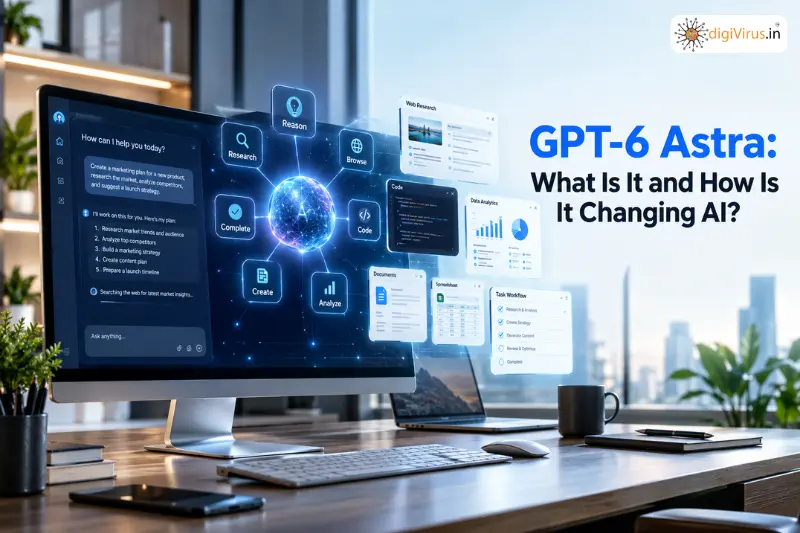
GPT-6 Astra: What Is It and How Is It Changing AI?
Artificial intelligence is evolving beyond basic Q&A systems. GPT-6 Astra, the most recent advancement from OpenAI, is intended to manage increasingly difficult tasks, function with various tools, and do multi-step activities with less human participation.
OpenAI claims that GPT-6 Astra, which was released in September 2026, is its most competent and aligned model to date. Astra is designed to operate with browsers, software, papers, code, research assignments, and professional workflows, in contrast to standard AI systems that primarily produce text or respond to inquiries.
What Is GPT-6 Astra?
OpenAI created the GPT-6 Astra, a cutting-edge AI model for complex, end-to-end tasks. It integrates computer use, browsing, coding, research, and document creation with sophisticated reasoning.
The fact that Astra can offer superior solutions is not the only significant distinction. It can also execute a series of actions to accomplish an objective.
An AI may, for instance, be asked to conduct research on a subject, compile the results, make a spreadsheet, make a presentation, and polish the final product in accordance with predetermined guidelines. This kind of linked workflow can be managed by Astra while maintaining focus on the initial goal.
Key Features of GPT-6 Astra
1. Advanced Reasoning
GPT-6 Astra is intended for complex situations that call for multiple reasoning steps. It is able to evaluate data, take into account various options, and modify its strategy in response to new demands.
This makes it helpful for jobs where a straightforward response is insufficient, such as research, technical analysis, business planning, and mathematics.
2. Computer and Browser Use
The capacity of Astra to communicate with computers and webpages is one of its most significant enhancements.
It can complete online forms, look up information online, update records, use software, and check websites, among other things. According to OpenAI, Astra outperformed its prior model in a number of computer-use assessments.
This may alter how AI is used for routine digital tasks. Users are increasingly able to assign portions of the workflow to an AI system rather than manually copying data between various applications.
3. Better Coding and Software Work
Software development is another goal of GPT-6 Astra. It can assist with software-related duties, work with development environments, write and troubleshoot code, and assess technical issues.
Astra’s main uses include coding, computer use, research, and advanced thinking, according to OpenAI’s model description.
This means that instead of being limited to producing particular code segments, AI may now be more involved in the entire development process for developers.
4. Professional Documents and Presentations
Astra’s capacity to generate documents, spreadsheets, presentations, and analyses while adhering to pre-existing templates and instructions is another noteworthy feature.
Businesses will find this especially helpful. Reports and presentations are frequently prepared for hours by marketing teams, consultants, researchers, sales teams, and management. The quantity of repetitive effort required in these procedures can be decreased with the help of a competent AI assistant.
5. Support for Scientific and Technical Research
Additionally, GPT-6 Astra is made for mathematical and scientific tasks. FrontierMath and GPQA Diamond, two assessments of advanced mathematics and science, show that OpenAI performs well.
Its capacity to integrate computer interaction and reasoning is particularly crucial. In addition to discussing data, researchers may be able to employ AI to work with specialist tools and analyze findings.
How Is GPT-6 Astra Different From Earlier AI Models?
In the past, AI models were frequently employed mainly as writing, brainstorming, coding, summarizing, and question-answering assistants.
GPT-6 Astra advances in completing the assignment.
The distinction is easily comprehensible:
Conventional AI
You ask, AI responds, and you handle the rest.
GPT-6 Astra
You supply the goal → Astra makes sense of the work → Makes use of the resources at hand → Generates the desired outcome.
That does not imply that people are no longer needed. Human judgment is still necessary for important decisions, particularly when the work includes money, sensitive data, legal issues, security, or economic ramifications.
What Does GPT-6 Astra Mean for Businesses?
The biggest impact could be on repetitive digital work.
Advanced AI systems can help businesses with a variety of tasks, including content creation, software testing, data analysis, reporting, market research, and customer information management.
An AI system might, for instance, facilitate a workflow for digital marketing teams that includes competitor research, keyword analysis, content development, reporting, and campaign documentation. Setting objectives, assessing outcomes, making strategic choices, and upholding brand direction would still require human marketers.
In this way, AI becomes less of a simple content generator and more of a digital work assistant.
Is GPT-6 Astra AGI?
GPT-6 Astra has generated considerable discussion around Artificial General Intelligence (AGI) because of its broader reasoning and computer-use capabilities.
However, it is preferable to keep a precise technical definition of AGI apart from marketing jargon and industry conjecture. Astra is a significant development in AI capabilities, although depending on the term being employed, any given model may or may not be formally categorized as AGI.
What is clear is that the technology is moving toward AI systems that can handle increasingly broad, complex tasks rather than performing only one narrow function.
The Future of GPT-6 Astra
The GPT-6 Astra signifies a change in the potential for human interaction with AI. Users are beginning to view AI as a technology that may assist in completing actual digital tasks rather than just as a chatbot.
It is especially pertinent to businesses and professionals since it combines thinking, computer use, coding, browsing, research, and professional document creation.
However, increased capability also entails more responsibility. Because of Astra’s enhanced cybersecurity and autonomous computer-use capabilities, OpenAI has highlighted additional safety measures.
Therefore, the true worth of GPT-6 Astra will depend not only on its capabilities but also on how individuals and organizations use it.
Conclusion
GPT-6 Astra is not your typical AI chatbot. It is a step toward AI systems that can comprehend a goal, use digital tools, reason in numerous steps, and provide useful outcomes.
This might result in less time spent on tedious digital duties and more time for strategy and innovative decision-making for companies, developers, researchers, and marketers.
The ability of robots to provide better answers to queries might not be the most significant development as AI develops. They could be able to assist people more and more in finishing the tasks associated with those inquiries.