

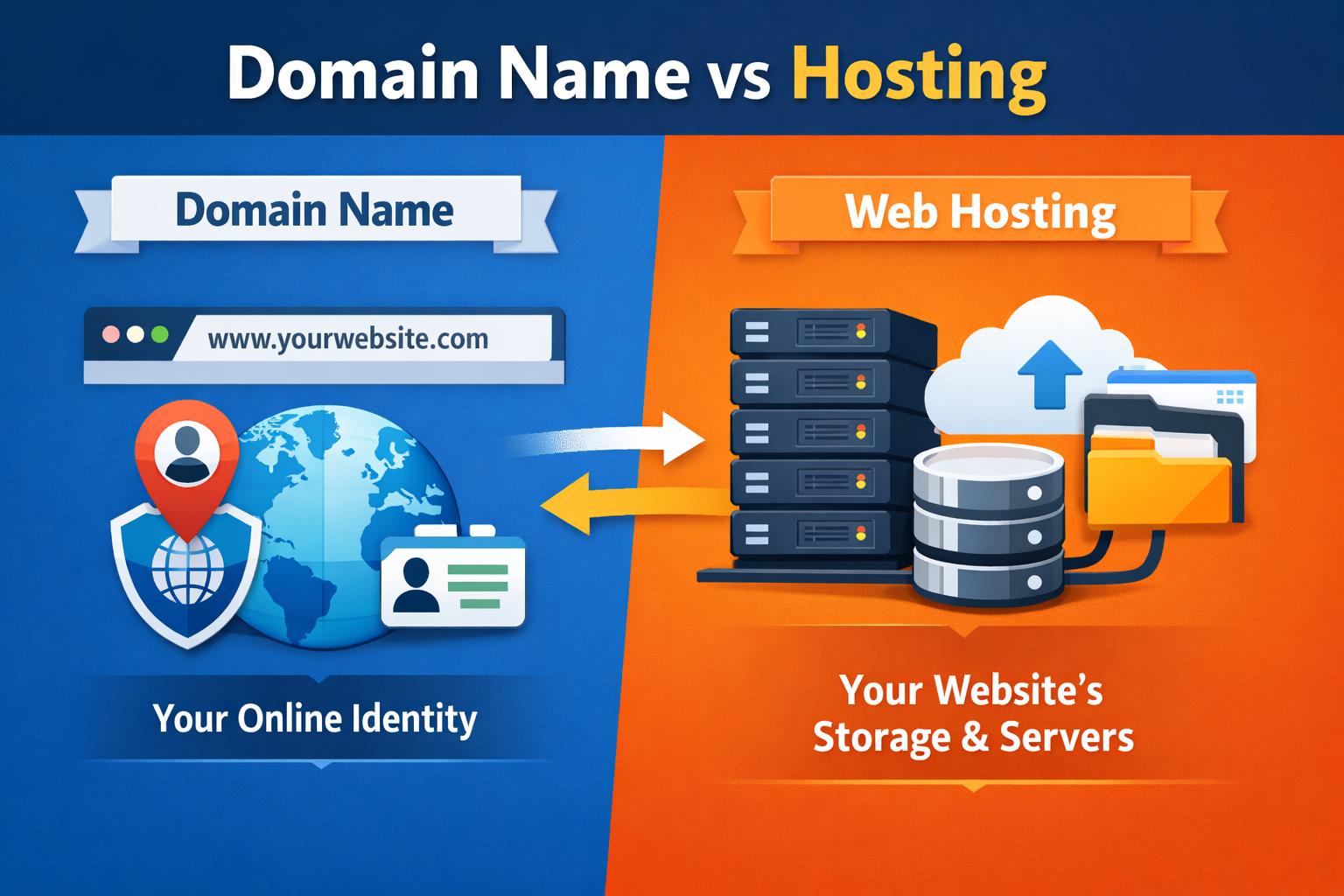
When starting a website, two terms you will hear repeatedly are domain name and hosting. Many beginners assume they are the same thing, but in reality, they serve completely different purposes. Understanding the difference between a domain name and hosting is essential for building and managing a website successfully.
What Is a Domain Name?
Your website’s online address is called a domain name. It is what users type into their browser to visit your site, such as www.example.com. Without a domain name, people would need to remember long numerical IP addresses, which is not practical.
Think of a domain name as the nameplate of a house. It helps visitors find your location easily. Each domain name is unique, meaning no two websites can have the same domain address.
Domain names are purchased and registered through domain registrars like GoDaddy, Namecheap, or Google Domains. They are usually paid for on a yearly basis and must be renewed regularly to remain active.
Common domain extensions include:
- .com
- .in
- .org
- .net
- .edu
Choosing the right domain name is important because it reflects your brand, improves credibility, and makes your website easier to remember.
What Is Web Hosting?
Web hosting is the service that stores all the files, images, videos, and data of your website and makes them accessible on the internet. Hosting providers maintain powerful computers called servers that run 24/7 to ensure your website is always available.
If the domain name is the address of a house, hosting is the actual house where everything is stored. Your website wouldn’t have a home without hosting.
Web hosting services come in different types, such as:
- Shared hosting
- VPS (Virtual Private Server) hosting
- Dedicated hosting
- Cloud hosting
Each type varies in performance, control, security, and price. Beginners usually start with shared hosting, while larger websites may require VPS or cloud hosting for better speed and scalability.
Key Differences Between Domain Name and Hosting
Although they work together, domain names and hosting are not interchangeable.
A domain name:
- Acts as a website’s address
- Helps users locate your website
- Is registered annually
- Does not store website data
Web hosting:
- Stores website files and databases
- Makes the website visible online
- Requires continuous server maintenance
- Determines website speed and performance
You can purchase a domain name and hosting from the same company or from different providers. Both options work as long as the domain is properly connected to the hosting server.
Why Do You Need Both?
To launch a functional website, you need both a domain name and hosting. The domain directs visitors to your server, while hosting delivers the website content to their browser.
Without a domain, users cannot easily find your site. Without hosting, there is nothing to display when someone visits your domain. Together, they create a complete and accessible website.
Which Should You Buy First?
There is no strict order, but many people prefer to buy the domain name first to secure their desired website name. Hosting can be purchased later and linked to the domain using DNS settings.
If you are building a professional website or online business, it is recommended to choose reliable hosting and a simple, brand-friendly domain name.
Conclusion
In simple terms, a domain name is your website’s address, while hosting is the space where your website lives. Both are essential components of any website and serve different but equally important roles.
Understanding the difference helps you make better decisions, avoid confusion, and confidently start your online journey. Whether you are creating a personal blog, business website, or e-commerce store, knowing how domain names and hosting work together is the first step toward success online.