

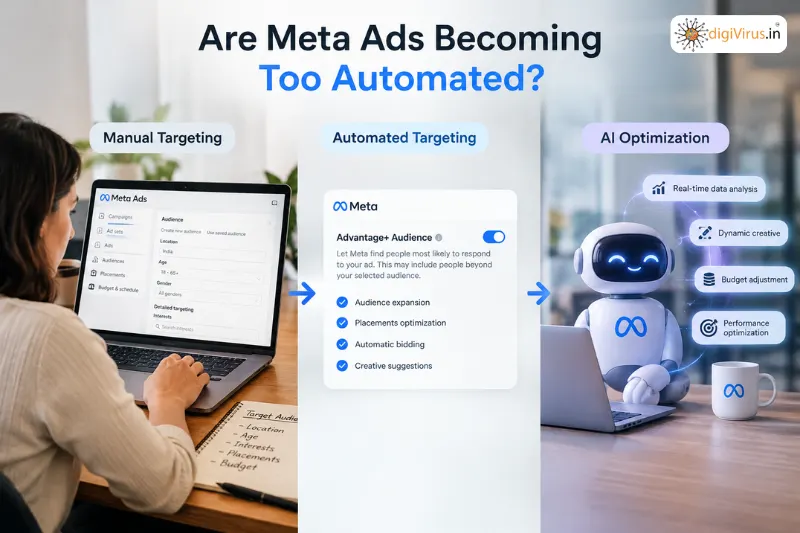
Are Meta Ads Becoming Too Automated?
Over the past few years, Meta Ads have seen tremendous transformation. Advertisers no longer need to manually choose audiences, placements, bidding tactics, and other campaign variables thanks to Meta’s automated algorithms. Machine learning-powered features are increasingly deciding who sees advertisements, where they appear, and how budgets are allocated.
The Rise of Automation in Meta Ads
Meta has been gradually moving toward automation to improve ad distribution and expedite campaign administration. Using solutions like Advantage+, advertisers may give Meta greater control over audience targeting, placements, creative combinations, and campaign optimization.
The Rise of Automation in Meta Ads Administration and enhanced ad delivery, Meta has been progressively pushing toward automation. Advertisers may offer Meta more flexibility over audience targeting, placements, creative combinations, and campaign optimization by using tools like Advantage+.
Instead of manually defining every feature, advertisers can provide Meta with business objectives, creative assets, conversion data, and budget limits. The platform then uses its algorithms to identify the users who are most likely to carry out the desired action.
This can lessen the amount of manual labor needed to manage campaigns for companies with adequate conversion statistics. Additionally, it can assist advertisers in reaching audiences that conventional targeting techniques might have missed.
Advertisers have less direct control over specific campaign choices as a result of increased automation, though.
Where Automation Helps Advertisers
When campaigns have specific goals and sufficient trustworthy data, automation might be helpful. User interactions, engagement patterns, conversion signals, and creative effectiveness are just a few of the many types of data that Meta can process far more quickly than a human marketer.
Delivery can also be modified by automated systems in response to evolving circumstances. For instance, the system might redirect delivery to people who share similar traits if one target segment starts producing more conversions.
This can make managing paid advertising simpler for teams and companies with limited resources. Marketers should concentrate more on creative planning, offers, landing pages, and conversion analytics rather than spending hours tweaking dozens of targeting variables.
Therefore, repetitive work can be eliminated by automation without necessarily eliminating the need for strategic thinking.
The Problem With Too Much Automation
It seems unlikely that meta advertising will be entirely automated or entirely manual in the future. Combining automation with human supervision is a more sensible strategy.
While maintaining control over the areas that call for business judgment, advertisers can let Meta handle routine optimization and delivery decisions. These consist of creative strategy, campaign goals, messaging, budgetary constraints, conversion quality, and performance analysis.
Therefore, whether Meta Ads are getting overly automated may not be the true question. It concerns whether companies are utilizing automation without knowing what it is optimizing for.
Advertising can become faster and more scalable with automation, but planning is still crucial. The most effective campaigns are probably those in which marketers maintain control over the campaign’s strategy, messaging, and business objectives while technology manages the intricacy of delivery.