

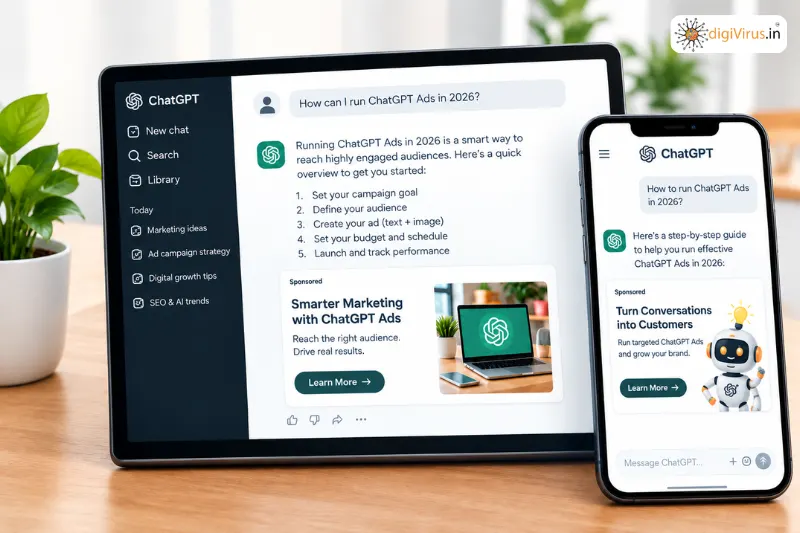
How to Run ChatGPT Ads in 2026
ChatGPT has grown in importance as a resource for product research, service comparison, problem solving, and next steps. Because of this, ChatGPT advertising differs from social media or conventional search advertising.
ChatGPT Ads can target conversational context and the intent behind what individuals are exploring, rather than just keywords or demographic interests. ChatGPT Ads, according to OpenAI, are a means for companies to connect with consumers as they consider possibilities, weigh their options, and make decisions.
The availability of ChatGPT Ads is not the only crucial question for companies thinking about using this new kind of advertising. It is the proper way to organize, start, oversee, and maximize a campaign.
1. Start With a Clear Advertising Goal
Before creating a ChatGPT Ads campaign, decide what the campaign is supposed to achieve.
A business may want to:
- Build awareness for a product or service
- Drive qualified traffic to a website
- Generate leads
- Increase product consideration
- Generate conversions or sales
CPM, CPC, and oCPC goals are listed in OpenAI’s current Ads Manager documentation. Reach and awareness are the focus of CPM, clicks and traffic are the focus of CPC, and downstream conversion actions are the focus of oCPC.
Selecting the goal initially aids in deciding on the campaign’s structure and metrics.
2. Understand How ChatGPT Ads Work
The purpose of ChatGPT Ads is to facilitate dialog. People might be looking for recommendations, studying products, comparing solutions, or asking inquiries.
When personalization is allowed, the ad system can take into account specific signals from a user’s overall ChatGPT experience as well as the context of the present chat.
This means advertisers should think beyond traditional keyword targeting.
For example, instead of creating an advertisement around only CRM software, a business could consider the wider problems people may be discussing, such as choosing CRM software for a small business, comparing CRM platforms, or finding a tool for managing sales leads.
The goal is to make the advertisement useful within the user’s decision-making journey.
3. Set Your Budget Carefully
Budget planning is one of the most important parts of running any new advertising channel.
Your budget should depend on the campaign objective, market, audience, expected traffic, conversion value, and testing requirements. There is no single budget that works for every business.
Start with a controlled testing budget rather than putting the entire advertising budget into the platform immediately. Use the initial campaign to understand impressions, clicks, conversions, costs, and which messages generate useful responses.
OpenAI’s Ads Manager allows advertisers to set campaign budgets, dates, countries, and other campaign settings.
The important point is to treat the first stage as a learning phase.
4. Create Multiple Ad Variations
One common mistake is creating one advertisement and expecting it to work for every situation.
OpenAI recommends building coverage with multiple title and copy variations. Different variations should communicate different angles instead of simply repeating the same message.
For example, one version can focus on a product benefit, another on a specific use case, and another on a common customer problem.
This gives the advertising system more useful creative options while also helping marketers understand which messaging resonates with their audience.
5. Make the Ad Clear and Useful
ChatGPT Ads should not feel like traditional promotional messages forced into a conversation.
The title should quickly communicate the value of the offer. The description should add useful information instead of repeating the headline.
OpenAI recommends clear, specific, benefit-focused messaging and accurate representation of the product or service.
A strong advertisement should answer three basic questions:
What is being offered?
Who is it useful for?
Why should the person consider it?
Keeping these points clear can make the advertisement easier to understand.
6. Choose the Right Visual
Visuals can play an important role in ChatGPT Ads because the ad format can include an image asset along with the advertiser name, title, copy, and landing page.
The visual should support the message rather than simply decorate the advertisement.
Avoid overcrowded designs, excessive text, misleading visuals, or images that do not represent the actual offer. A clean product-focused image, realistic service visualization, or relevant use-case creative can make the advertisement easier to understand.
Testing different visual concepts can also help identify which creative direction works better.
7. Connect the Ad to a Strong Landing Page
Getting a click is only one part of the campaign.
If the landing page is slow, confusing, irrelevant, or inconsistent with the advertisement, the campaign can lose potential customers after the click.
The landing page should match the promise made in the ad and provide a clear next step. Depending on the campaign, that could be purchasing a product, submitting a lead form, booking a consultation, signing up, or learning more.
Conversion measurement is therefore important when evaluating campaign performance.
8. Track Results and Optimize
Launching the campaign is not the end of the process.
Review performance regularly and look at metrics such as impressions, clicks, click-through rate, conversion activity, cost, and overall return.
OpenAI has introduced measurement capabilities including the OpenAI Pixel and Conversions API to help advertisers understand actions that happen after ad engagement.
Use these insights to improve weak advertisements, test new messaging, adjust budgets, and refine campaign structure.
9. Avoid Common ChatGPT Ads Mistakes
Several mistakes can reduce campaign effectiveness:
- Using the same message in every ad variation
- Writing vague or overly promotional copy
- Creating visuals that do not match the offer
- Sending users to an unrelated landing page
- Starting with an unrealistic budget
- Ignoring conversion tracking
- Making claims that cannot be supported
- Failing to review OpenAI’s advertising policies
OpenAI requires ad creative, images, and landing pages to comply with its advertising policies, and misleading or prohibited content can result in rejection.
Conclusion
ChatGPT Ads represent a different approach to digital advertising because they operate within a conversational environment where people are actively exploring questions and making decisions.
The strongest approach is not simply to create an advertisement and increase the budget. Businesses should begin with a clear objective, create useful and varied messaging, use relevant visuals, connect ads with strong landing pages, track meaningful conversions, and continuously optimize based on performance.
As the ChatGPT advertising platform continues to evolve, marketers who understand both the technology and the fundamentals of advertising will be better positioned to use this channel effectively.