
1 Campaign, 10,000 AI Variants: Scaling Personalization without Human Effort
Customers no longer react to generic ads in the realm of digital marketing today. Consumers want brands to be aware of their preferences, behavior, and areas of interest. Simply said, a single advertisement that is visible to everyone no longer functions as it once did. For this reason, one of the key components of effective marketing efforts is now personalization.
The problem is that it is nearly impossible to manually create customized advertisements for thousands of clients. It requires an excessive amount of time, money, and effort. This is the point at which artificial intelligence is totally altering the game.
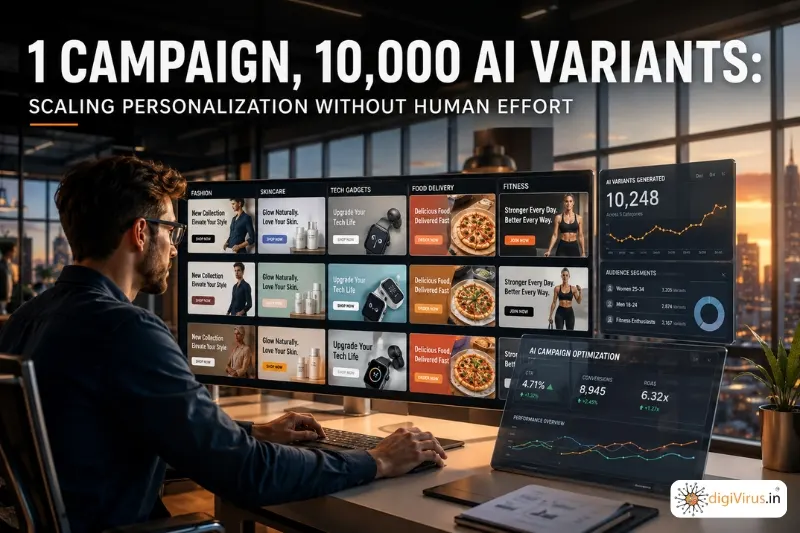
Brands may now automatically generate thousands of ad variations from a single campaign thanks to AI-powered advertising. You don’t need a big creative team to personalize headlines, images, audience targeting, product recommendations, and ad copy. Higher conversions, reduced ad fatigue, and improved engagement are the outcomes.
Why Traditional Ad Creation Slows Down Growth
Marketing teams had to manually produce many ad variants prior to the widespread use of AI solutions. Designers and copywriters had to produce distinct creatives for every audience if a brand wished to target different cities, age groups, interests, or consumer habits.
Consider an online retailer of sneakers, for instance. They might require:
- Distinct advertisements for men and women
- Different creatives for casual users and fitness enthusiasts
- Variations in regional languages
- YouTube, Facebook, and Instagram-specific designs
It can take weeks to personally create each of these. Marketers still need to determine which version of the advertisements performs better after they go live.
This procedure is costly, time-consuming, and challenging to scale.
How AI Creates Thousands of Variations Automatically
Advertising platforms with AI capabilities can provide several ad combinations in a matter of minutes. Instead of creating each advertisement by hand, marketers supply the system with essential campaign components like:
- Product images
- Brand guidelines
- Headlines
- Target audience data
- Marketing goals
The AI then creates thousands of possible combinations by changing:
- Ad copy
- CTA buttons
- Colors
- Layouts
- Product placements
- Audience targeting
- Video formats
This allows businesses to launch hyper-personalized campaigns at a massive scale without increasing human workload.
For example, a skincare brand can automatically show:
- Anti-aging products to older audiences
- Acne solutions to teenagers
- Hydrating products to users in dry-weather regions
All of this happens automatically using customer behavior and AI-based optimization.
Better Personalization Means Better Results
Increased consumer involvement is one of the main benefits of AI advertising. Ads that seem relevant to them are more likely to be clicked.
Users typically dismiss advertisements that they see repeatedly. Ad fatigue is the term for this. By continuously updating creatives and presenting various iterations to various audiences, AI assists in resolving this issue.
As a result, businesses often experience:
- Higher click-through rates
- Better conversion rates
- Lower advertising costs
- Improved return on ad spend (ROAS)
AI also helps marketers test campaigns faster. Instead of manually running A/B tests for weeks, AI systems can analyze performance in real time and automatically prioritize winning ad variations.
AI Advertising Works for Every Industry
AI-driven personalization is no longer limited to large global companies. Businesses of every size can now use it.
eCommerce Brands
Online stores use AI to recommend products based on browsing behavior, cart history, and purchase patterns.
Healthcare & Wellness
Clinics and wellness brands personalize ads based on age groups, health interests, and location targeting.
SaaS Companies
Software companies create different ad experiences for startups, agencies, enterprises, and freelancers.
Local Businesses
Restaurants, gyms, salons, and retail stores use AI ads to target nearby customers with localized offers.
No matter the industry, personalization helps brands connect better with customers.
The Future of Advertising Is AI-Powered
Marketing is shifting toward intelligent decision-making and automation. In the future, companies that stick to traditional advertising strategies might find it difficult to compete.
AI boosts creativity rather than replaces it. The brand’s strategy, marketing, and vision are still developed by human marketers. AI merely makes campaigns run more quickly and effectively.
Artificial intelligence and human ingenuity work together to enable marketers to grow campaigns without adding to operational strain.
AI-powered advertising techniques at digiVirus assist firms in developing more intelligent campaigns that instantly adjust to consumer behavior. Modern AI solutions are assisting organizations in achieving greater performance with less manual labor, from audience optimization to creative generation.
Conclusion
In digital marketing, personalization is no longer optional. Consumers want brands to provide relevant experiences, and AI enables this on a large scale.
Businesses may now start a single campaign and instantly create thousands of customized variations instead of making ads one at a time. This improves targeting, lowers expenses, saves time, and produces better outcomes.
Brands that can integrate creativity, analytics, and AI-driven automation to produce marketing experiences that consumers genuinely want to interact with will win the future.